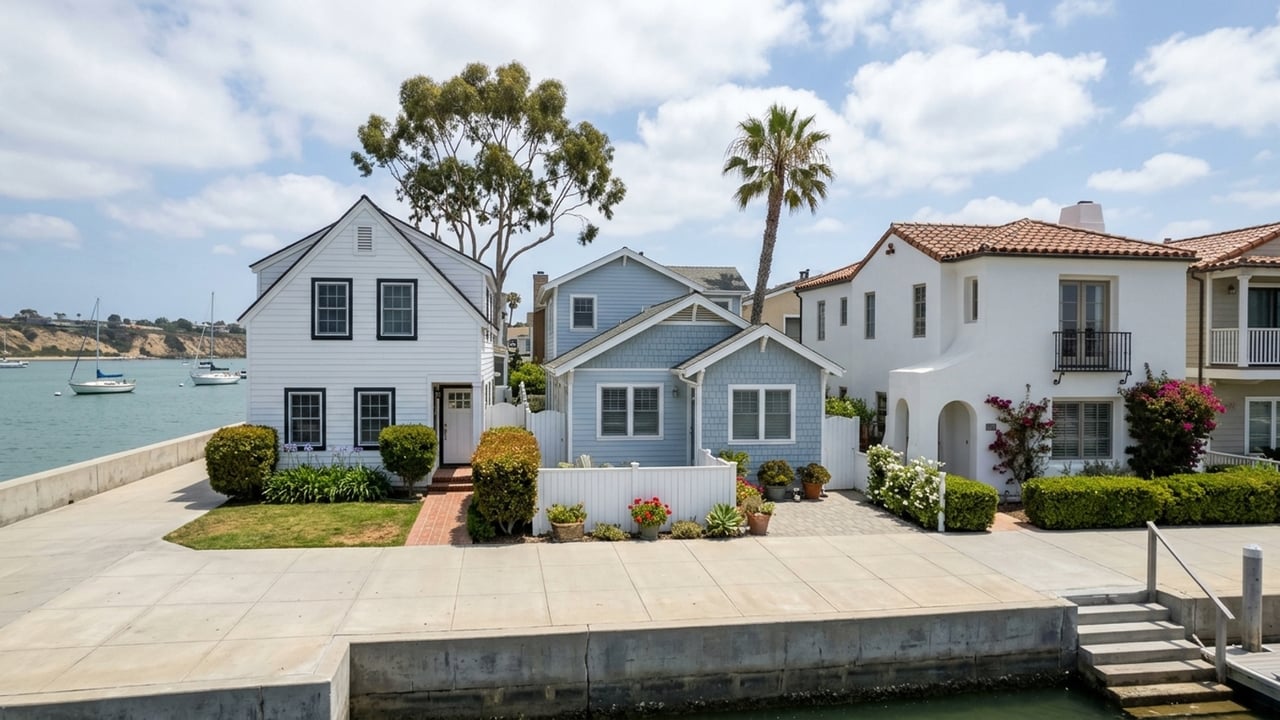
Newport Beach's defining history isn't its 1906 incorporation. It's the early-20th-century dredging that created its most famous waterfront, including Balboa Island, Lido Isle, and the harbor entrance.
Key takeaway
Newport Beach's story is a harbor that was largely built, not found. A sandbar bay became a working port, then a resort, and early-20th-century dredging created its waterfront. If you're using that history to choose an area, start with the split. Engineered harbor land like Balboa Island and Lido Isle comes with flood and seawall questions, while bluff-top Newport Heights and later-annexed Newport Coast do not share that past. Check a lot's history before you pay for it.
Who this guide is for
You want to understand how Newport Beach came to be, or you're weighing different parts of the city and want to know which areas sit on built-up harbor land and which grew on natural or later-annexed ground.
Newport Beach history timeline
Before any dredging began, the bay was a shallow estuary lined with sandbars and sandspits that made sailing a ship in genuinely difficult.
Tongva and Acjachemen land and the rancho era
Upper Newport Bay was home to the Tongva and Acjachemen peoples for thousands of years prior to Spanish contact. Before 1769, the Tongva lived in seasonal village sites, using wickiup shelters while families fished, hunted, and gathered food from the bay and surrounding mesas.
Later, the area became part of Rancho San Joaquin, a roughly 48,803-acre Mexican land grant formed from grants to José Antonio Andrés Sepúlveda in 1837 and 1842. Facing drought, Sepúlveda sold the rancho in 1864 to James Irvine, Thomas and Benjamin Flint, and Llewellyn Bixby.
Much of today's eastern Newport Beach traces back to this grant, which eventually became the Irvine Ranch. Little of this era is visible now. Archaeological sites are protected rather than displayed, so don't expect preserved landmarks.
The 1870s landing and the McFadden wharf
The bay was a hard-to-enter natural harbor until September 10, 1870. That day, Captain Samuel S. Dunnells and William A. Abbott entered it on the sternwheel steamer Vaquero. James Irvine, Benjamin Flint, James McFadden, and Robert McFadden designated the landing a "new port," and that name stuck to the bay.
Because ships struggled to cross the bar into the bay, the McFadden brothers completed an ocean wharf in the winter of 1888 to 1889. Connected by railroad, it served as a shipping point for Orange, San Bernardino, and Riverside counties until 1907. Newport Pier stands where that wharf once was.
The port ultimately failed as a commercial harbor because of the dangerous mouth and shoaling bay. That failure pushed the next era toward resort lots instead.
The Red Car, Balboa and incorporation in 1906
In 1905, the Pacific Electric Red Cars extended service to the Balboa Peninsula, delivering vacationers from Los Angeles. To attract lot buyers, the Newport Bay Investment Company built the Balboa Pavilion in 1905 and the Balboa Pier as a sister project in 1906. The City of Newport Beach incorporated on September 1, 1906, just as that resort boom was taking off.
The Balboa Pavilion still stands on the bay today. What you trade for those early resort lots is space. They were small parcels laid out on a sandspit, and peninsula homes still sit on narrow lots wedged between the ocean and the bay.
Which parts of Newport Beach are man-made?
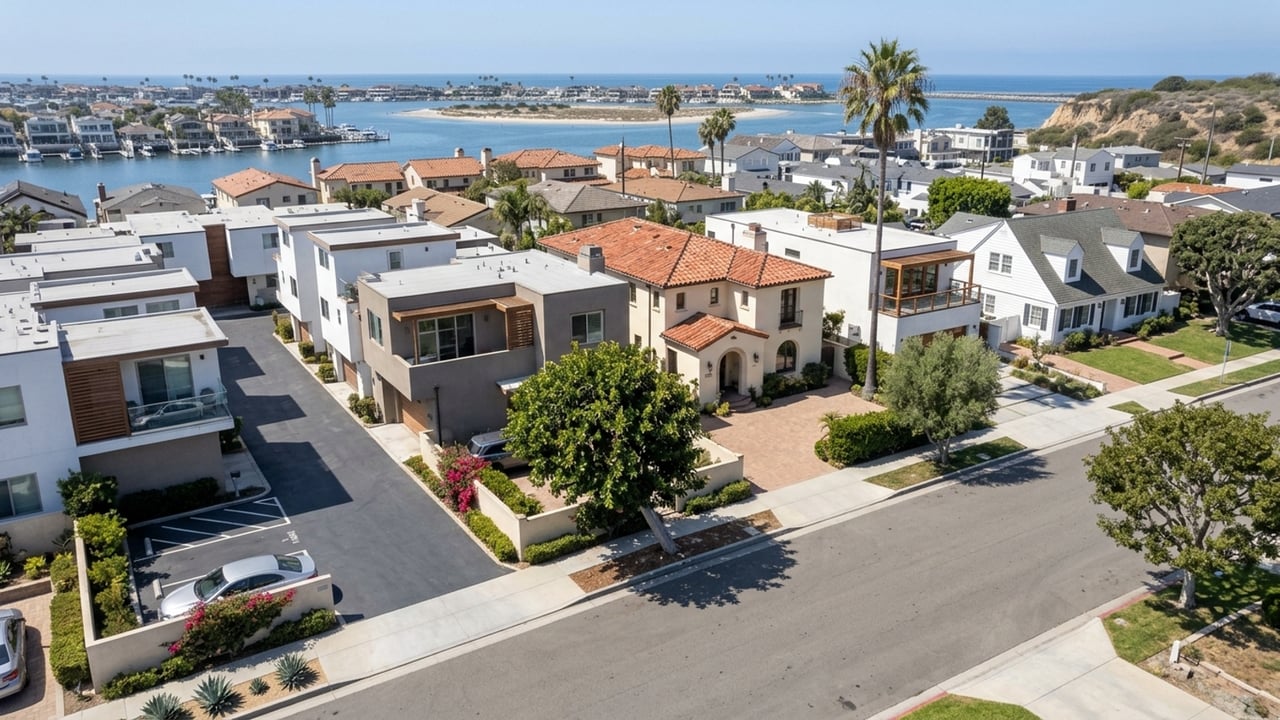
The islands and deep-water channels were engineered over decades of dredging and filling. That built-up land sits at harbor level, so homes there face different conditions than properties on natural bluffs.
Balboa Island
In 1908 and 1909, W.S. Collins moved a small dredge to a mud flat called Snipe Island in the eastern part of the bay. He cut a channel along the north side of the bay across from the Pavilion and piled the sand and silt onto the mud flat to create the island. The new land was sold as small cottage lots, which is why the grid is so tight and the streets so walkable today.
The island relies on its perimeter seawall during high tides. If Balboa Island is on your list, ask the seller for any flood history and for the seawall's age and condition before you go further.
Lido Isle
Lido Isle was a later dredge-and-fill project, developed as a planned residential island in the 1920s. W.K. Parkinson spent more than a quarter-million dollars dredging the harbor and using the fill to raise the isle more than ten feet above the high tide line. He renamed it in homage to Lido di Venezia. Its layout differs from Balboa Island's cottage grid, with wider streets and a more deliberate master-planned approach.
It still sits on fill, though, so bulkhead condition and flood exposure are part of every purchase here.
Newport Harbor entrance and the 1936 dedication
The harbor wasn't reliably navigable until a major federal and county project in the 1930s. Local bonds were passed in 1933, and work on jetties and dredging started in December 1934. Opening celebrations were held on May 26, 1936, with President Franklin D. Roosevelt starting the dedication ceremony via a telegraph key at the White House.
That project, more than the city's incorporation, created the deep-water bay and harbor-front addresses Newport Beach is known for. The catch is that a dredged harbor has to be maintained. Silting and dredging remain an ongoing public cost and a recurring local issue.
Balboa Peninsula
The Balboa Peninsula is a natural sandspit, not fill, though the harbor works reshaped it. It holds the two piers that anchored the early resort era.
What you give up on the peninsula is protection from the elements. It's exposed to both ocean surf and tidal bay flooding, and those narrow early lots leave little yard space.
How Newport Beach grew beyond the harbor
As the harbor filled in, development moved inland onto the natural bluffs and down the coast. It spread through separate annexations and master plans that had nothing to do with dredging. The Irvine Company's land holdings and the gradual absorption of independent coastal villages shaped this side of the city.
Newport Heights
Newport Heights sits on the natural bluff above the bay, which means harbor proximity without the islands' low-lying, built-up land. As one of the older residential areas off the water, it mixes original architecture with newer construction on the same early streets.
Many homes have been rebuilt or will need work, so get inspections of original systems.
Corona del Mar
Corona del Mar was its own community until Newport Beach annexed it in February 1924, giving residents access to reliable city services. It developed separately from the harbor dredging on natural coastal land, and it still reads as its own place today.
The village identity and coastal location draw heavy visitor traffic and parking pressure near the beaches. Tour the area on a summer weekend before you decide whether you can live with the crowds.
Newport Center and Fashion Island
This is where the shift from harbor town to master-planned city is easiest to see. Fashion Island opened on September 9, 1967, as a $20 million, 75-acre shopping center with parking for 5,500 cars. The Irvine Company developed it as the anchor to the Newport Center district, the modern, inland chapter of the city's story.
What you give up is the harbor-era character people picture when they search the city's history. This part of Newport Beach is built for planned convenience, not historic atmosphere.
Newport Coast
This former Irvine Ranch hillside was developed into gated communities and joined the city only recently, annexing into Newport Beach effective January 1, 2002. It's the clearest contrast with the dredged islands: newer construction on natural hillside terrain rather than harbor fill.
Many communities carry more than one homeowner association layer. Ask for every association's current dues and CC&Rs before comparing it with older parts of the city.
What Newport Beach history means for buyers today
Whether a property sits on dredged fill or natural bluff shapes flood insurance, remodel restrictions, and long-term maintenance. The market also treats historic and newer areas differently. Buyers evaluating these conditions often consider the pros and cons of living in Newport Beach.
Newport Beach housing market today
The citywide median jumped 13.2% over the 90 days ending September 30, 2026, but that figure mostly reflects which homes sold. The single-family median of $4,810,582 rose 6.6% year over year, while the condo median slipped 0.9% to $1,894,805 (based on 58 condo sales).
For the lowest entry price into the historic harbor districts, start with condos on and around the Balboa Peninsula. With condo prices flat and a sale-to-list ratio of 97.6%, you have some room to negotiate. These figures are citywide, and neighborhood pricing on Balboa Island can differ sharply from Newport Coast.
Flooding history on the harbor's low-lying land
The islands and peninsula were built up from mudflats and sandbars, so they sit at or near the high-tide line. These areas have a documented history of coastal and tidal flooding. The city sets top-elevation standards for bulkheads and seawalls on harbor-front lots.
Flood exposure still varies lot by lot. Check the FEMA flood map, ask for the seller's disclosure and any insurance claims, and get a flood insurance quote before you write an offer.
Historic landmarks and older homes
The City of Newport Beach General Plan's Historical Resources Element sets out a classification system for locally designated historic properties. Four properties in the city are listed as California Historical Landmarks. The 1905 Balboa Pavilion was one of the city's first landmarks, and the 1926 Lovell Beach House is a nationally recognized resource. That classification system protects the character of older homes on the peninsula, the islands, and in the Heights.
Historic-resource status can limit demolition and exterior changes. Ask the city's Planning Division whether a property is listed before you budget a remodel.
Where to see Newport Beach history in person
Several local institutions preserve the records and artifacts of the harbor's development. The Balboa Island Museum covers the dredging and cottage-era resort days. The Newport Beach Historical Society maintains an extensive oral history collection. Sherman Library & Gardens in Corona del Mar focuses on the broader history of the Pacific Southwest, and the Newport Beach Public Library offers local history resources. Confirm current hours and admission with each venue before visiting.
How to use this history to narrow your search
Your choice comes down to historic harbor proximity versus natural elevation and newer construction. Ask yourself these questions as you review homes:
- Do you want a home on the water itself? Start with the man-made harbor sections and check the flooding history before touring.
- Do you prefer older streets on natural high ground? Focus on Newport Heights and Corona del Mar.
- Do you want newer, planned construction more than historic character? Look at Newport Center and Newport Coast, and budget for HOA layers.
- Are you planning to renovate an older home? Check the historic landmarks section first, because historic-resource status can shape what you're allowed to change.
At a glance
- All homes: median sale price $3,848,167, up 13.2% year over year (90 days ending 2026-09-30)
- Single family: median sale price $4,810,582, up 6.6% year over year (90 days ending 2026-09-30)
- Condo: median sale price $1,894,805, down 0.9% year over year (90 days ending 2026-09-30)
- Median price per square foot: $1,779 single family, $1,115 condo, $1,642 all homes (90 days ending 2026-09-30)
- Median days on market: 65 single family, 70 condo, 65 all homes (90 days ending 2026-09-30)
- Sale-to-list ratio: 96.7% single family, 97.6% condo, 96.9% all homes (90 days ending 2026-09-30)
- Share sold above list: 9.1% single family, 8.8% condo, 8.9% all homes (90 days ending 2026-09-30)
- Months of supply: 3.8 single family, 4.5 condo, 4.2 all homes (90 days ending 2026-09-30)
- Homes sold: 200 single family, 58 condo, 284 all homes; inventory: 251 single family, 85 condo, 391 all homes (90 days ending 2026-09-30)
Newport Beach history FAQs
Does Newport Beach have two piers?
Yes. Newport Pier stands on the site of the 1888-89 McFadden wharf, and the Balboa Pier was built in 1906 as a sister project to the Balboa Pavilion.
What is Newport Beach known for?
Its dredged harbor and the Newport Beach Christmas Boat Parade. The parade traces its origins to July 4, 1908, when gondolier John Scarpa organized a lighted boat parade.
Is Newport Beach one of the wealthiest cities?
It depends on how you measure wealth, but home values are high. The all-homes median sale price was $3,848,167 over the 90 days ending September 30, 2026.
What was Newport Beach named after?
It was named after the 1870 steamer landing on the bay, which its founders designated a "new port."
What county is Newport Beach, CA in?
It is in Orange County, CA. Orange County was officially formed on August 1, 1889, after separating from Los Angeles County following a vote by local residents.
When did the Red Car stop running to Newport Beach?
Service ended in 1940. The Newport Beach to Balboa segment was reduced to a single daily round trip in June 1940 and fully abandoned on November 18 of that year.
What is the seawall height requirement in Newport Beach?
The city's bulkhead and seawall top-elevation standard applies during new construction or major repairs. Ask the seller or a contractor for the existing wall's measured elevation to see how it compares.
When was Balboa Island created?
W.S. Collins dredged and filled the mud flat that became Balboa Island in 1908 and 1909, then sold the new land as small cottage lots.
What is the difference between Balboa Island and Lido Isle?
Both are dredge-and-fill islands in Newport Harbor. Balboa Island was created in 1908 and 1909 and has a tight cottage-lot grid, while Lido Isle was developed in the 1920s with wider streets and a master-planned layout.
Sources
- Redfin: Data Center
- Newport Beach Historical Society: City of Newport Beach
- California Historical Landmarks: CHL 198
- Historical Marker Database: McFadden Wharf
- Wikipedia: Balboa Pier
- Visit Newport Beach: History of Balboa Island
- Wikipedia: Lido Isle, Newport Beach
- OC Parks: Newport Harbor History
- Corona del Mar Historical Society: History
- Wikipedia: Fashion Island
- City of Newport Beach: Document View
- City of Newport Beach: Historical Resources Element
- Orange County Department of Education: Origin Story
- Historical Marker Database: Tongva and Acjachemen
- Wikipedia: Rancho San Joaquin